Courting Sustainability
The development of Coppinger Court, a high density apartment complex on Popes Quay, Cork City, has been broadly received with a warm response, picking up awards in 2004 including the RIAI Best Sustainable Building award.

Welcome to the archive of Construct Ireland, the award-winning Irish green building magazine which spawned Passive House Plus.
The feature articles in these archives span from 2003 to 2011, including case studies on hundreds of Irish sustainable buildings and dozens of investigative pieces on everything from green design and building methods, to the economic arguments for low energy construction.
While these articles appeared in an Irish publication, the vast majority of the content is relevant to our new audience in the UK and further afield. That said, readers from some regions should take care when reading some of the design advice - lots of south facing glazing in New Zealand may not be the wisest choice, for instance.
Dip in, and enjoy!
The development of Coppinger Court, a high density apartment complex on Popes Quay, Cork City, has been broadly received with a warm response, picking up awards in 2004 including the RIAI Best Sustainable Building award.
Patrick Daly, co-founder of the RiSE (Research in Sustainable Environments) research unit in the DIT has undertaken an in depth study and critique of the current Irish Part L for energy efficiency in dwellings, comparing it in detail to the UK equivalent. The findings raise challenging questions about the Irish standards and methodology and highlight serious shortcomings in comparison to our UK neighbours, permitting substantially higher levels of CO2 emissions from new homes in Ireland than in the UK.
During his tenure as energy minister Eamon Ryan instigated plans to energy upgrade Ireland’s draughty, damp housing stock. Ryan and his wife, writer Victoria White, show Construct Ireland how their own home has been given the green treatment, and architect Mike Haslam of Solearth describes the project.
The winner of the sustainability award at the 2011 Irish Architecture awards, Roebuck Castle student residence at UCD’s Belfield campus is also the biggest certified passive house project built to date in Ireland and the UK. Tony Rigg of Kavanagh Tuite Architects explains how such a significant building achieved passive results.
Newly inaugurated RIAI president Paul Keogh selects four diverse UK projects that integrate sustainability without compromising on design
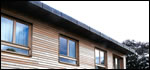
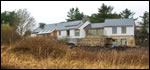
Any building, no matter how cold and draughty, no matter how remote, can be improved to world-class energy performance, as an upgraded and extended Donegal cottage dating back to the 1800s proves.
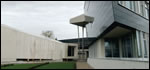
As long term readers of Construct Ireland will recall, the mainstreaming in recent years of sustainable design and construction has been exemplified in many innovative local authority offices. John Hearne visited Aras Contae an Chláir, and discovered a building which attempts to holistically minimise environmental impact, with attention paid to more than just energy performance and carbon emissions.