
- Government
- Posted
Housing minister calls for faster retrofit to shield homes from energy shocks
Ireland must treat building decarbonisation as critical national infrastructure to protect households from future energy price shocks, according to a new policy scorecard launched today.
Ireland needs to dramatically accelerate the retrofitting of its homes, schools and businesses to build resilience against future energy price shocks, the Irish Green Building Council's 2026 Policy Scorecard has warned.
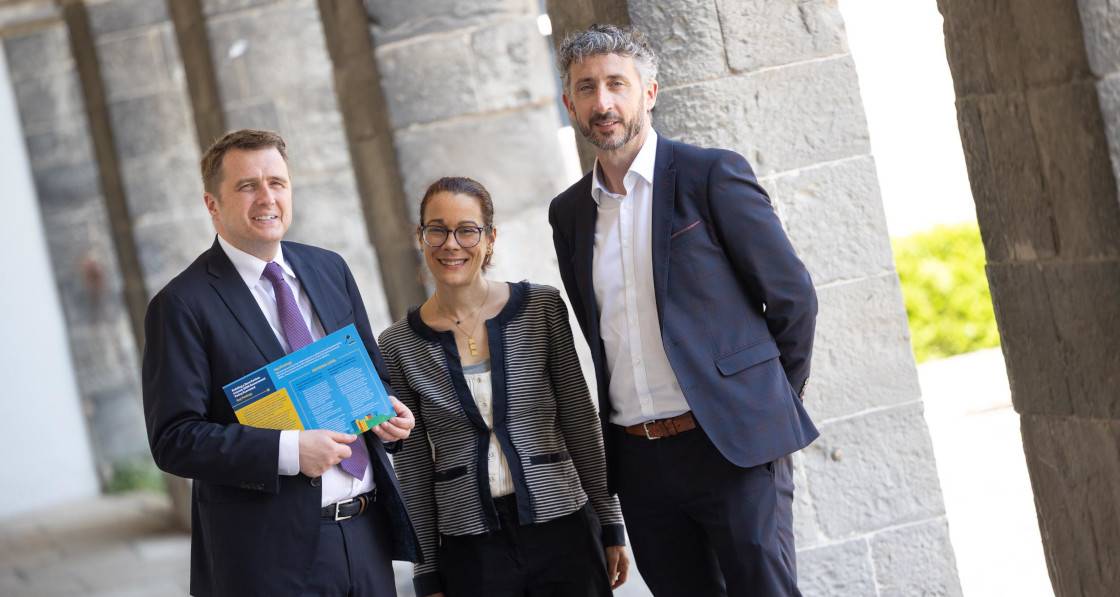
The scorecard was launched at the IGBC's Build Green Now conference at Royal Hospital Kilmainham in Dublin on Wednesday 27 May, where around 250 delegates heard that while progress has been made on decarbonising the built environment, ambition must now be stepped up significantly.
Speaking at the event, Minister for Housing James Browne TD, pointed to timber construction as a particular priority, arguing it could speed up delivery times and cut costs while still achieving the highest energy ratings. His department is working with the Timber in Construction Steering Group on national technical standards for Mass Engineered Timber, which are close to publication.
IGBC chief executive Pat Barry said Ireland had led on energy renovation for a decade but needed to go further.
"Decarbonising our buildings must be seen as a key national infrastructure project to make us more resilient to energy price shocks, and deliver healthier, more comfortable homes that are more affordable to heat," he said, pointing to Spain and Denmark as countries that had weathered the recent energy crisis better due to heavy investment in renewables.
A panel discussion heard that tackling vacancy and dereliction could play a significant role in both housing delivery and carbon reduction. John Dobbin, chair of the RIAI Housing Committee, said bringing vacant and derelict buildings back into use offered a unique opportunity to revitalise cities, towns and villages. Because the infrastructure is already in place, it could allow the state to deliver homes faster and more cheaply than new builds on greenfield sites.
The conference also looked at international innovation, including Copenhagen's new Fælledby district, the Danish capital's first all-timber neighbourhood, designed for 7,000 residents as a climate-resilient urban village.
On the business case for sustainability, Steven McGee, chief operating officer at John Sisk & Son, said lower carbon equates to lower cost.
"By investing in sustainability now, we deliver efficient, future-ready assets that create lasting value," he said.
Related items
-
 EU Electrification Action Plan to accelerate heat pump transition
 -
 Accessible Manchester retrofit delivers comfort and low bills
 -
 Planning reform will thwart low energy housing, councils say
 -
 Cairn secures passive house certification for three Dublin developments
 -
 UK net zero carbon standard accepts passive house as compliance route
 -
 Women make up just 11 per cent of Ireland's construction workforce, says CIF